HARUMI · TOKYO PORT RAILWAY, HARUMI LINE · TOKYO
A freight bridge that carried its last train in 1989 reopened as a walkway in 2025. One year on, the rails are still under your feet.
Akiko Makimura / Walked March 2024 & October 2025, revisited 2026 / Practical info current as of September 2026
I have a weakness for old civil engineering, and within that, railway relics get me every time. Old steel bridges. Lines where no train will ever run again.
On 19 September 2025, an old railway bridge over Tokyo’s Harumi Canal reopened as a public walkway. I have been three times: once while it was still a construction site, and twice since. It is that kind of place — the bridge itself, and the waterfront it sits in.
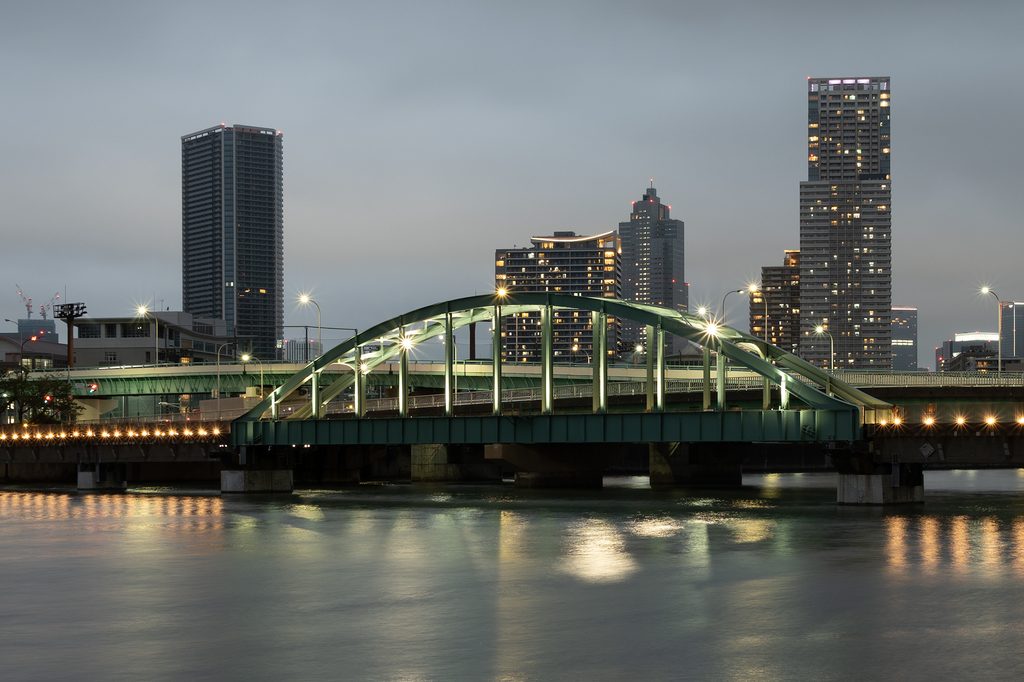
A year after the walkway opened, my third visit was at dusk. As the city lights came on, so did the bridge’s own. The whole stretch of canal glowed like a starfield in warm colors.
A quick bearing before we start. Harumi and Toyosu are two blocks of reclaimed land on Tokyo Bay, a short way east of Ginza: Toyosu is where the fish market moved in 2018, Harumi is where the athletes’ village stood for the 2021 Olympics. The Harumi Canal runs between them, and two bridges cross it side by side — Harumi-bashi, a road bridge from 1973, and, just to its south, the old railway bridge this story is about.
March 2024: A rust-red arch
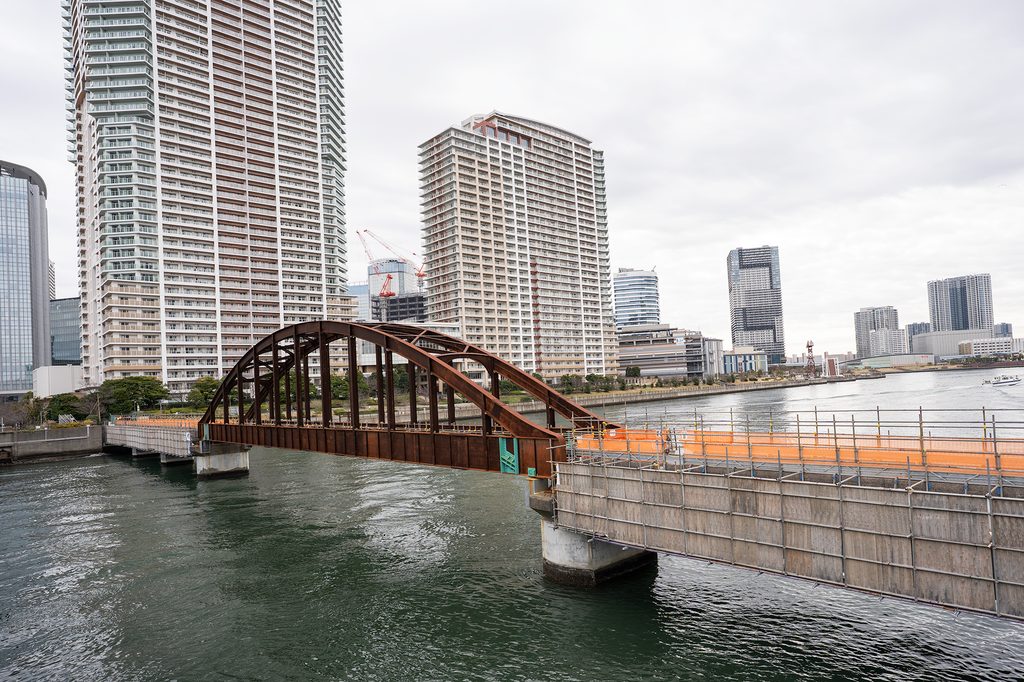
When I first came, in the spring of 2024, the bridge was rust-red.
Harumi-bashi runs right alongside it, so I could photograph the whole thing from the road bridge’s footpath. Both ends of the arch were wrapped in construction hoardings; repair work was under way. Look closely at the ends of the arch and you can see that a few parts were already a bright green. I had no idea, taking that photo, that those green parts would later bother me so much that I would fall down a research rabbit hole trying to find out what they were.
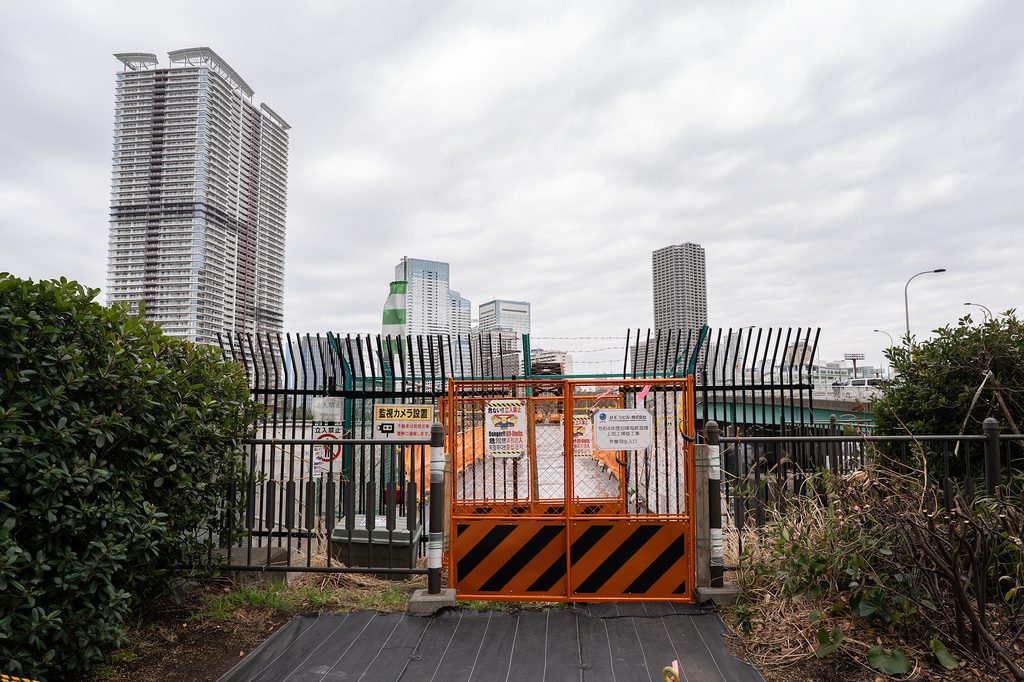
I crossed Harumi-bashi from the Harumi side toward Toyosu and walked round to the south end. There, an orange construction gate blocked the old trackbed.
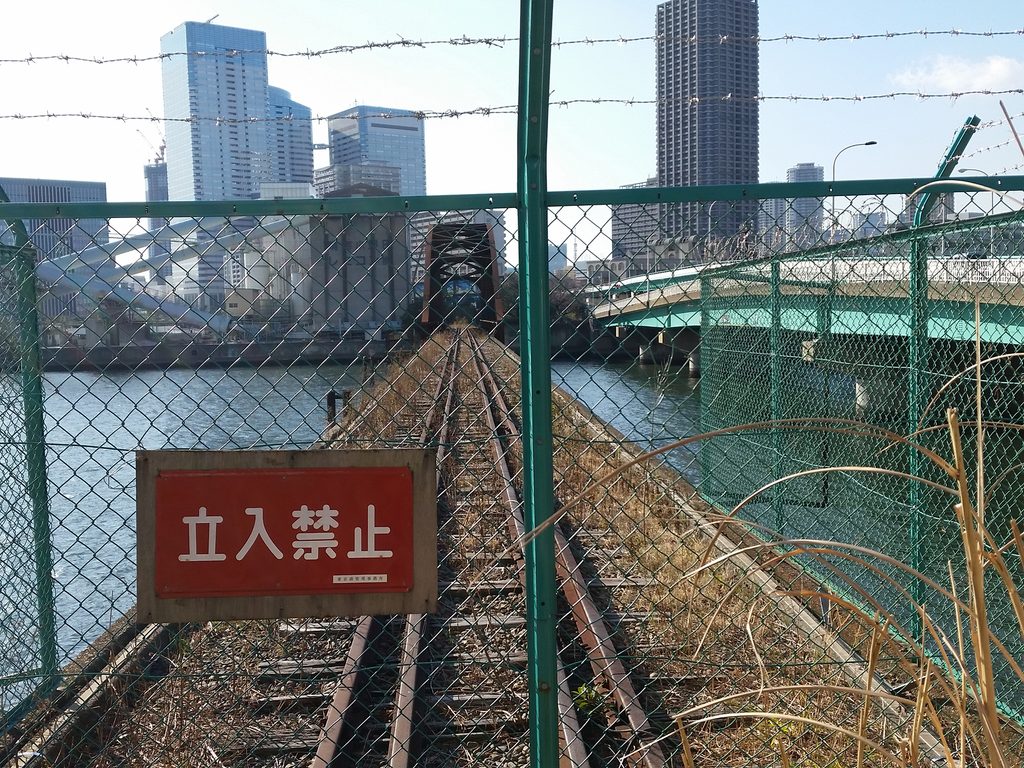
There is a photograph on Wikimedia Commons taken from the same angle in 2015. The line had been dead for a quarter of a century by then, but the picture still has something in it — as if a diesel locomotive might come rumbling up out of the far end at any moment.
October 2025: Two rails set into the floor
The last train crossed this bridge in 1989. Thirty-six years later, ordinary people could walk across it for the first time. I went about two weeks after the walkway opened.
The walkway is a wooden deck, and set into it are the rails that used to carry the trains.
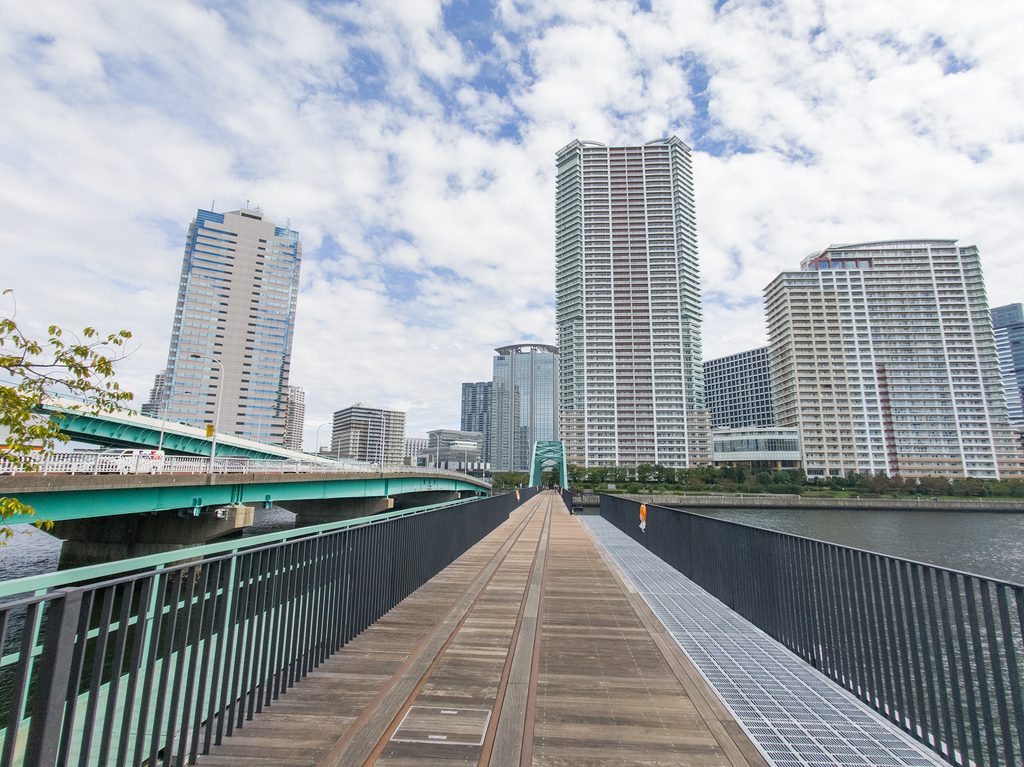
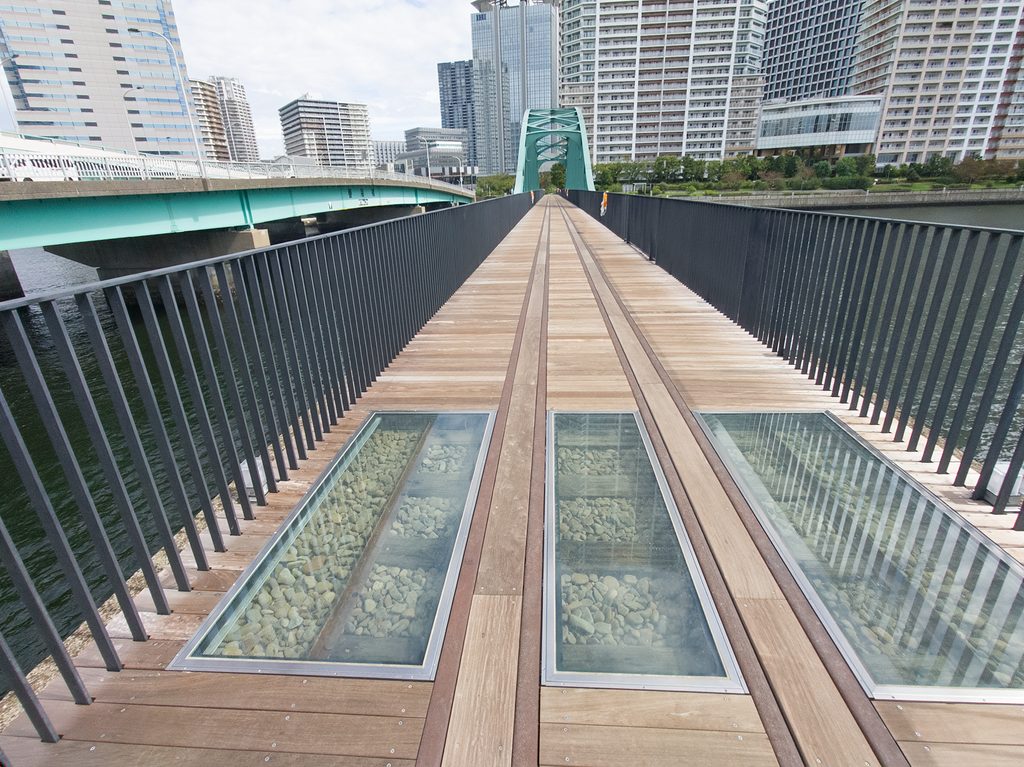
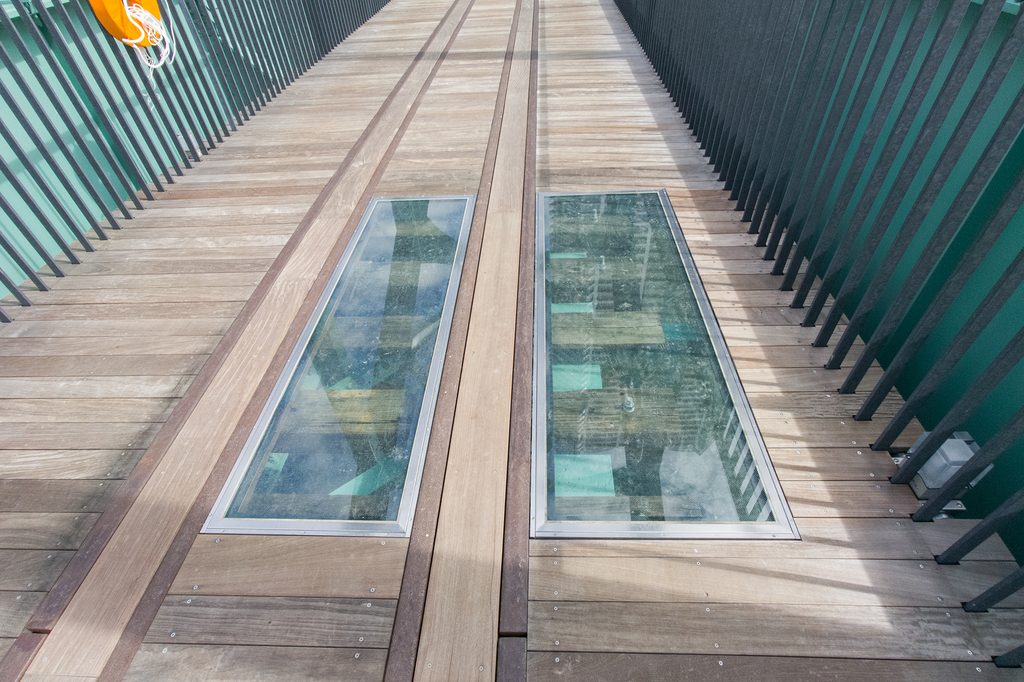
In several places the wooden deck gives way to panels of glass floor. What is interesting is that the view under the glass changes as you go.
The panel below is on one of the prestressed-concrete girder sections, at either end of the arch. Here the sleepers and ballast, which had been taken out for the repair work, have been put back. It recreates what used to lie beneath the rails.
There are glass panels on the steel arch section too, and under these there is no ballast — only sleepers. That is how the bridge was built: on the arch, the track ran on an open deck, with no ballast at all. The glass shows you the difference.
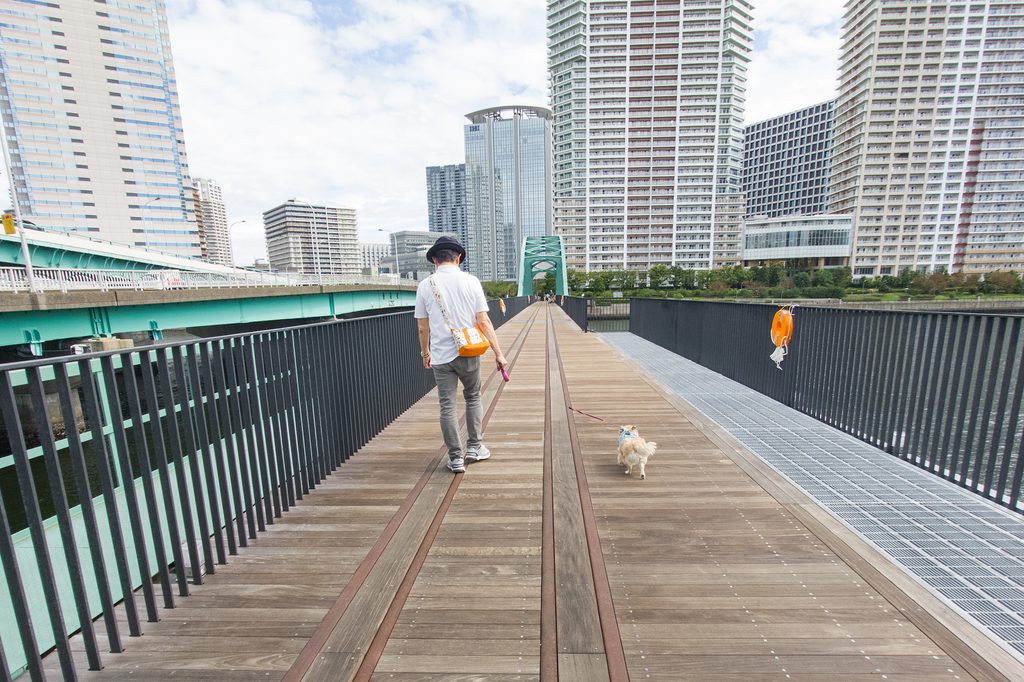
A man with a small dog walked ahead of me, tracing the line of the rails with his steps. Freight wagons used to roll along these rails. Now people walk on them.
Out on the arch, I stopped and looked up. Green steel against a blue sky.
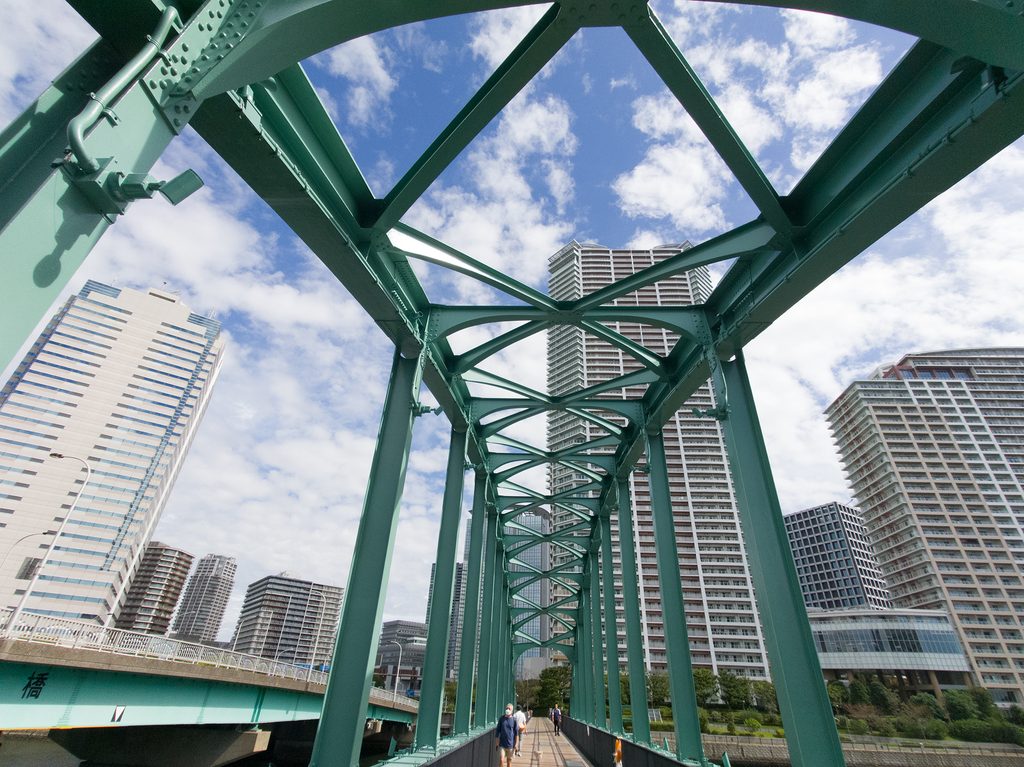
1957: How the bridge came to be
So what was this bridge?
- Type: three-span continuous prestressed-concrete girder + steel through-type Lohse girder (arch) + three-span continuous prestressed-concrete girder
- Length: 190.3 m (the central arch span is 58.8 m)
- Width: 3.8 m
- Completed: 1957
A steel arch in the middle, with continuous prestressed-concrete girders on either side. The Tokyo Metropolitan Government’s Bureau of Port and Harbor was the owner; the work was commissioned to the national railways (JNR), and the design was done by JNR’s Tokyo construction office.
A Lohse girder is a type of arch bridge in which the arch and the deck girder share the load between them — from a distance, it reads as an unusually thick arch. A prestressed-concrete girder is one where the concrete is squeezed in compression before it ever carries a load, so that it can resist the tension that would otherwise crack it. “Continuous” means the girder runs unbroken over the piers instead of being cut into separate spans. According to the information board at the foot of the walkway, this was the first railway bridge in Japan to use either — a Lohse arch or continuous prestressed-concrete girders.
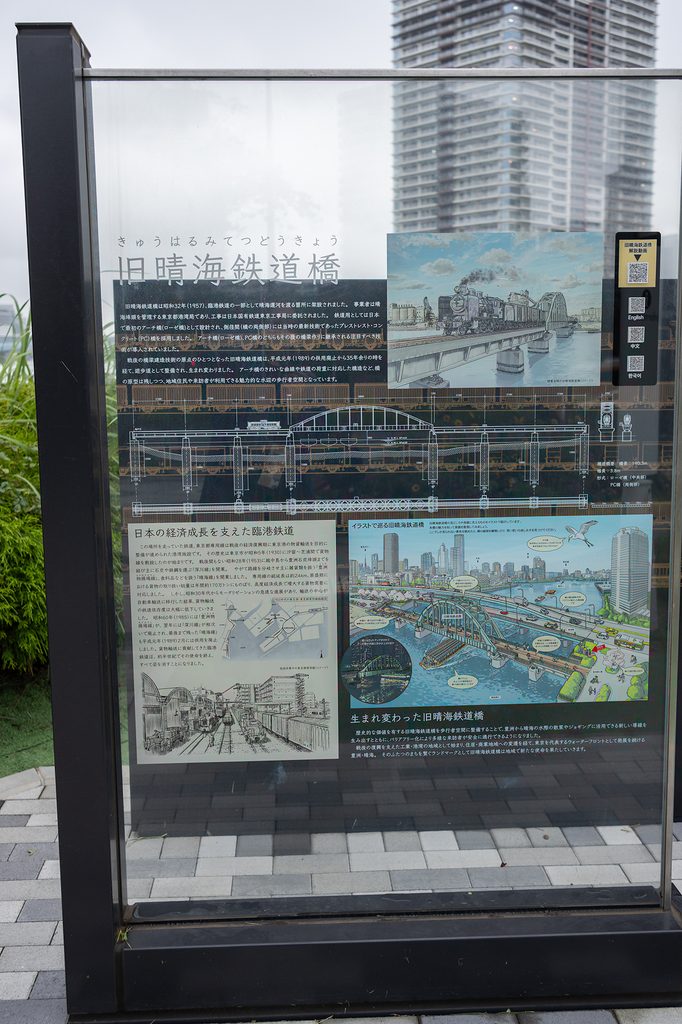
The Harumi Railway Bridge was built in 1957 as part of the Tokyo Port Railway, the freight lines that the Bureau of Port and Harbor ran between the docks and the national rail network. It carried the Harumi Line between Toyosu and Harumi.
The port railway went back to 1930, when the City of Tokyo laid a freight line from Shiodome to Shibaura. After the war, in 1953, the Fukagawa Line opened from Etchujima to the coal wharf at Toyosu, hauling coal and steel. From there the network branched: a line to the Toyosu landing stages for general cargo, and the Harumi Line for things like wheat and newsprint. At its peak the system ran to about 24 km of track and handled around 1.7 million tonnes a year. There was a time when goods landed at the Port of Tokyo were carried by rail wagon to the edge of the city center.
| Year | Event |
|---|---|
| 1930 | City of Tokyo lays a freight line from Shiodome to Shibaura |
| 1953 | Fukagawa Line opens (Etchujima – Toyosu coal wharf) |
| 1957 | Harumi Railway Bridge built |
| 1985 | Toyosu landing-stage line closed |
| 1986 | Fukagawa Line closed (except the Harumi branch) |
| 1989, Feb. | Harumi Line closed — the last line left |
1957 was twelve years after the war. The Tokyo Metropolitan Government describes this bridge as “one of the starting points of Japan’s post-war bridge-building technology.” I find it rather moving that the starting point was not some grand bridge on a main road, but a working bridge built to carry freight.
Then came the age of the truck, and the freight lines closed one by one. The Harumi Line was the last, and it finished its job in February 1989. After that the bridge was simply closed off, and the years went by.
Why part of a rusted bridge was already green
Work to turn the bridge into a walkway began in 2021: first seismic strengthening of the piers and substructure, then repair and reinforcement of the superstructure, repainting, and finally the walkway itself, in stages.
At the start of this story I mentioned that a few parts of the rusted bridge were green. What were they?
I went back to the photos and enlarged them. Once you can see the parts clearly, even an amateur can tell that these are components that were attached later.
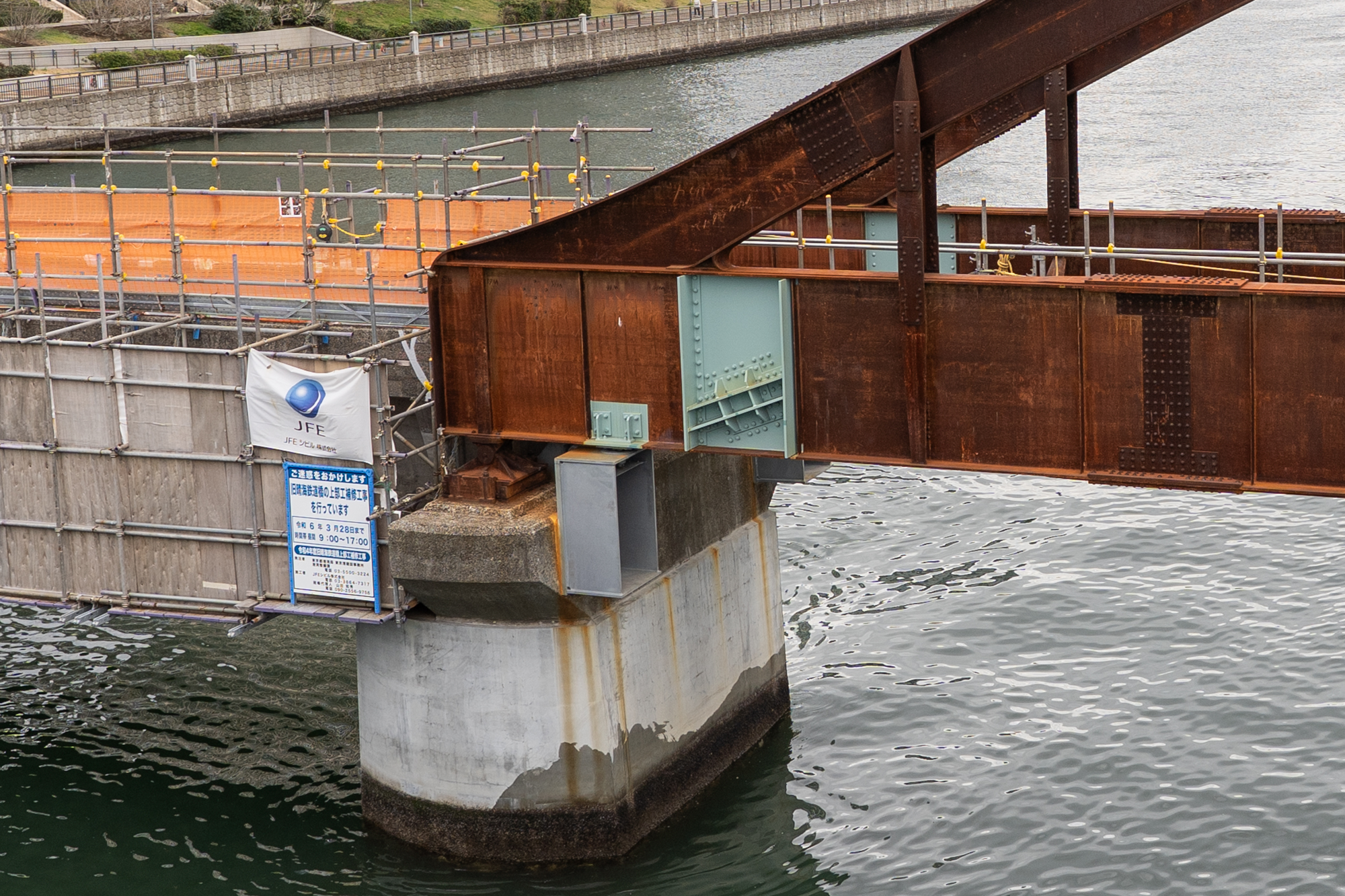
In March 2024 there were four of them visible from outside. The interesting thing — see the enlargement below — is that the green on the left and the green on the right are not quite the same shade. Some of that is the light, of course. But to my eye they are the same family of color with a different degree of dullness.
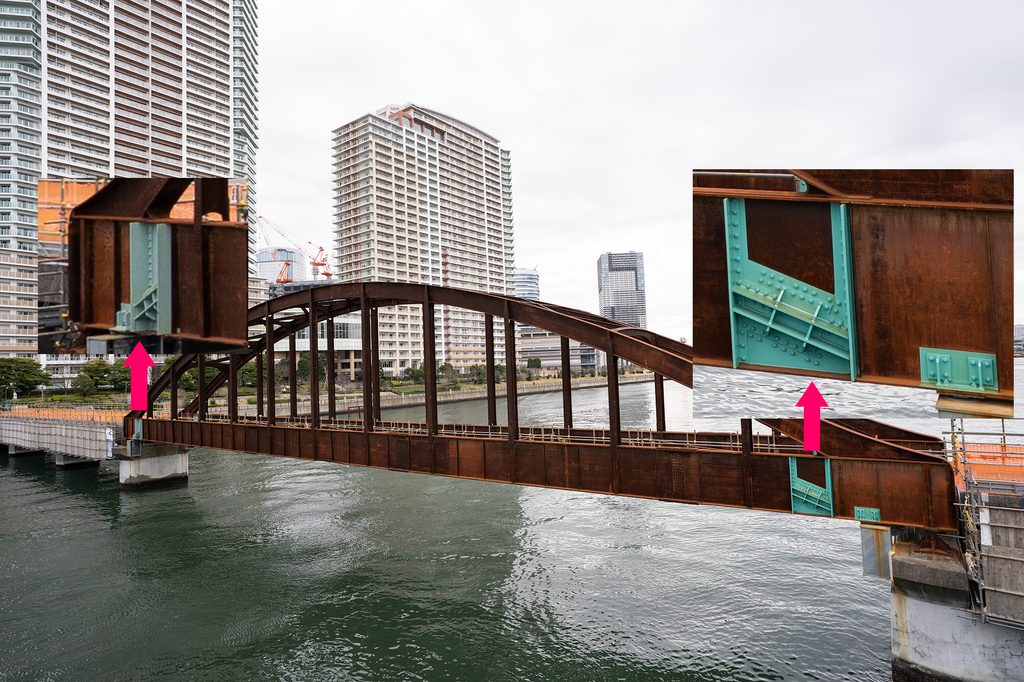
And then this one, taken after completion: the whole bridge repainted in a single, even color, the same color it was built in.
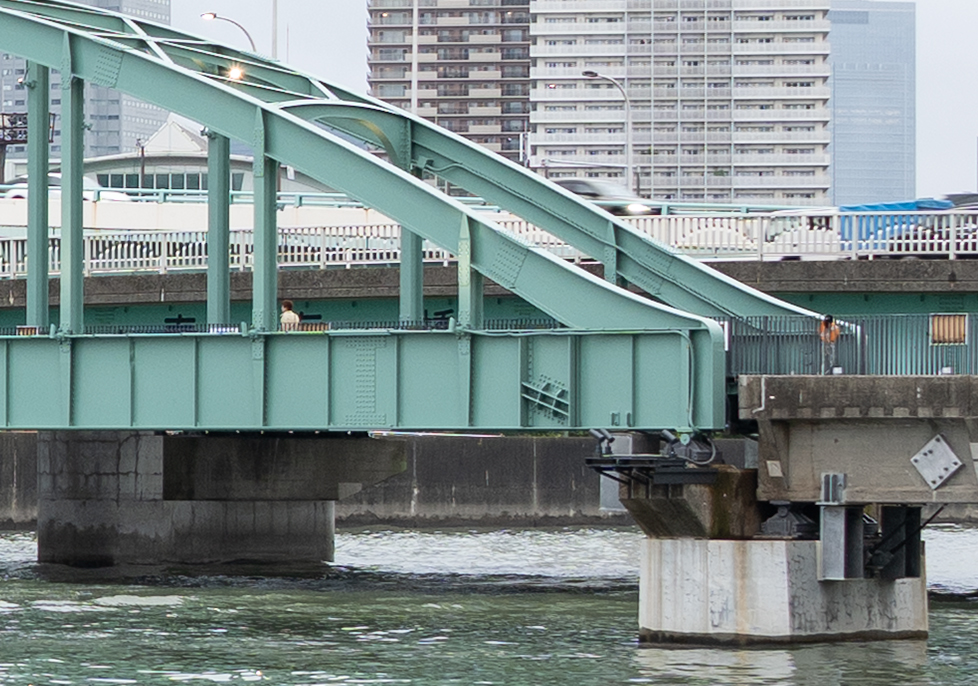
Putting the photographs together with what I could find in the project records, the green parts appear to be reinforcement members fitted to strengthen the bridge during the repair works. When the decision was made to repaint the whole bridge in its original color, I don’t know. Whether the green on those few parts was exactly the green of the finished walkway, I don’t know either. But given that even the reinforcement members were not quite the same shade as each other, my guess is that they were painted first, in roughly the intended color, before the rest caught up. (It is a guess. The real story may be entirely different.)
2026: One year on
Back to the dusk I began with.
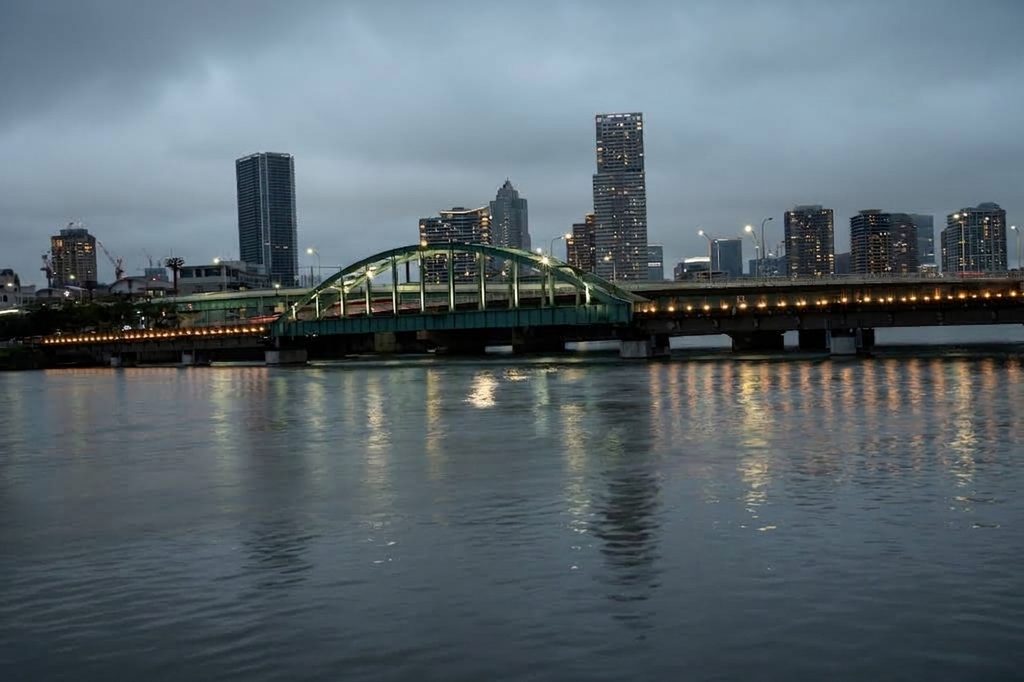
When the sun goes down, the lights in the walkway come on. The green steel floats in the light, and its shape is mirrored in the canal. The windows of the towers behind, and the lamps on the bridge. The water goes smooth, and the bridge looks as if it is breathing, quietly.
A year after the railway bridge was reborn, it is full of joggers and dog-walkers. Toward evening, people on their way home from work cross from Toyosu to Harumi. A bridge built 3.8 meters wide for freight wagons turns out to be exactly the right width for people on foot.
The railway bridge has been reborn, and it now sits inside people’s everyday lives as if it had always been there. Or perhaps “reborn” is not quite the word. Perhaps it simply came back.
A series called “The Memory of Rails”
What happens to rails after the trains stop coming? Looking back over the places I have walked, they fall into roughly four kinds:
- Left as they were — the rails are still there, untouched
- Kept on purpose — preserved by someone’s decision
- Reborn — given a different job
- Gone — no longer in the ground at all
The old Harumi Railway Bridge is two of these at once. For a long time, neither the bridge nor its rails were removed; they were simply left. Then, after a long debate over what to do with the remains of the railway, it was decided to keep them, and the bridge was reborn as a walkway.
“The Memory of Rails” is a series of walks to see what shape the rails are in now, wherever the trains have stopped. This is the first. The old rails are set into the floor of a new bridge, and we can walk on them.
(The other walks in this series are on my Japanese site for now. They will come across to this shelf as it grows.)
Getting there
Transport, prices, and access arrangements in this area change frequently. Everything below was verified on the date above. Please check official sites before you travel.
- Where: Harumi Canal, between Harumi (Chuo Ward) and Toyosu (Koto Ward), Tokyo. The walkway is part of Harumibashi Park.
- Access: about 12 minutes on foot from Toyosu Station (Tokyo Metro Yurakucho Line / Yurikamome), or about 14 minutes from Tsukishima Station (Yurakucho Line / Toei Oedo Line). The Toei bus stop “Harumibashi” is right beside it.
- Use: pedestrians only.
- Lighting: the walkway itself is lit after dark; the bridge is lit up from 7 p.m. to 11 p.m.
- Accessibility: step-free, designed to be barrier-free.
- On site: an information board at the foot of the walkway, with a QR code to an explanatory video by the Bureau of Port and Harbor (Japanese only).
- The classic view of the whole bridge — the one in my March 2024 photo — is from the footpath of Harumi-bashi, the road bridge immediately to the north.